MACCHINA PER IL TEATRO INCOSCIENTE

UTM.2.1 - AUDACI IMPRESE (Brave Feats)
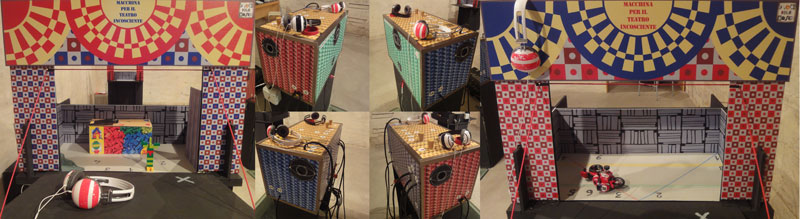
These machines play about the great subjects of romance.
The weapons, women, loves and spells echoing in ‘Orlando Furioso’ appear inside three sets. They can be played in any order bringing to life the many-sided ambience of the poem.
Ironical quotations and homages paid to the ‘Opera dei Pupi’ are the countermelody to Ariosto's work.
This set of machines has been born after conversations and considerations on the long and deep work of Mimmo Cuticchio, master of ‘Pupi’ and ‘Cuntu’, that wanted it in his fesitval ‘La Macchina dei Sogni’ in 2013.
click here for videos (in Italian) 1 and 2

UTM.2.2 -DIARIO DI VIAGGIO (Journal)
In several minutes you play and create a pictorial book.
An old journal (born, itself, under dictation) is described to the unconscious Operator, with words that lead him/her to produce plates illustrating situations.
While the plates take shape, the Spectator hears the story of the journey.
The game continues with the Spectator telling to his/her fellow (formerly Unconscious Operator) the story he heard while they look together at the plates of the newborn book.
On leaving, the players will take with them the plates, so they will be able to tell the story to anyboddy every time they want to.
click here for a video (in Italian)
UTM.2.3 - BLOWIN’ IN THE WIND
Two machines paying homage to William Shakespeare while playing about fixing the destiny.
2.3 machines are based on the usual rules of UTM but they push forward the research about the relationship between drama and objects by focusing on two peculiar elements.
The first one is obtained by dedicated stage sets, working in the same time as realistic environments for the objects as they appear to the Operator, as well as symbolic scenographies for the play heard and seen by the Spectator.
The other one, a hallmark of our Company, is the study of the influence of objects on the stories they are used for. We have made this influence even more palpable by telling the same story twice, by means of two different sets of objects.
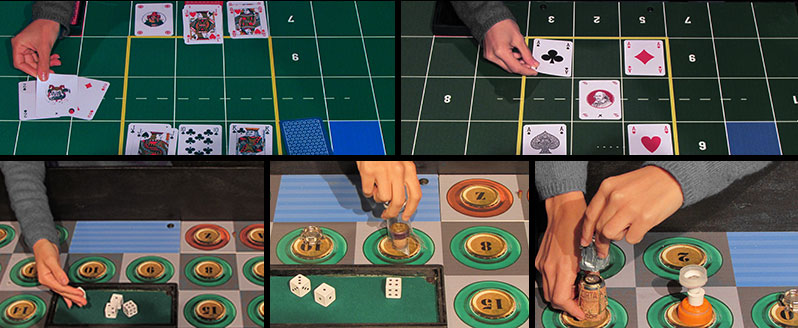
There are two gambling tables, one for cards, one for dice with counters like in 'snakes (chutes) and ladders' game.
From the very beginning, the randomness that should rule the game proves itself fake: every card, every throw of the dice obeys the orders of the Bard, or of his main character, and pushes the events forward along the plotted line.
The table becomes stage, the objects are, in turn, characters, concepts, ghosts; The game becomes play; the object/characters move in the game, the hands move the play.
On both tables is staged the same comedy, but the objects modify its coming to life: the actual shows are two different shows.
The one who attends both can enjoy the story seen from different points of view and is plunged in a wavering world of daily object flavoured with Elizabethan scents.